
Doug Ford’s reason for sending $200 to Ontario residents was so they could stimulate the economy by buying sneakers. But with the cheques arriving in the new year, how is this not taxpayer-funded pre-election gimmick?
Some people will be happy to get the money, thinking it’s theirs anyway. But the province is in a deficit situation, so Ford will be forced to borrow the $3 billion to cover the giveaway. Then it will have to be repaid, with interest, estimated to cost $140 million a year…and every year until it is paid back.
It is good that Ford recognizes that people need support, but one can think of more effective ways this kind of money could make a difference in peoples’ lives.
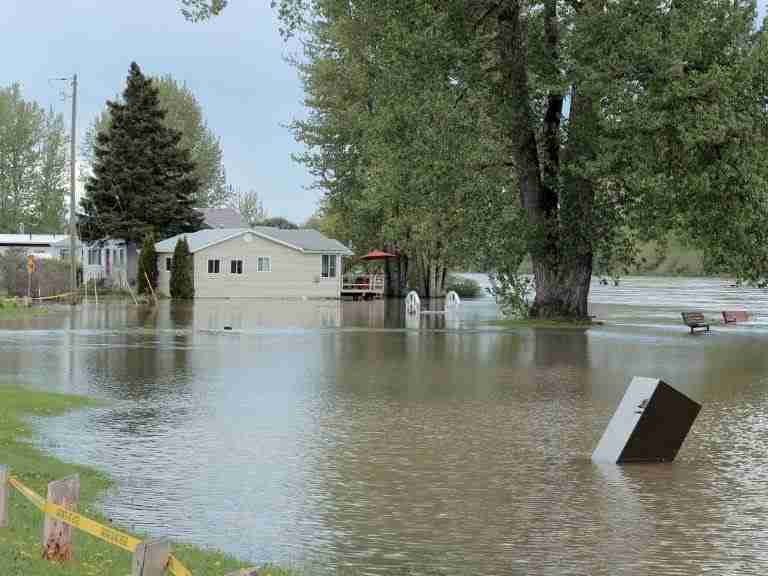
With the back-to-back “100-year” storms this summer – yet another wake-up call about climate breakdown – a more lasting and economically stimulating use for the money would be to invest in climate adaptation measures. Climate change is costing Canadians billions of dollars, increasing the costs faced by households and governments alike. Whether it be our day-to-day costs, or the increased taxes and premiums we face, or the impacts on our health and economy, climate change is costing us big time. You could say it is draining our pocketbooks.
The infrastructure that we depend on for our health and safety was not designed for the weather that we have now, much less what we can expect in the all-too-near future. This summer’s flooding reinforced that reality. Municipalities, which own about 70% of our public infrastructure, are on the front lines of climate adaptation, of taking action to protect residents from impacts of climate breakdown.
Flooding is the most costly of extreme weather events. In addition to failures of our aging – even ancient – stormwater infrastructure, floods are caused by land development that reduces the green spaces and wetlands that absorb water. Torrential rains are becoming more frequent.
A flood of costs from flooding
In 2018 it was estimated that the cost of repairing a flooded basement was $43,000. It will cost much more than that now. And for every dollar of damage that is covered by insurance, there’s an additional $3 to $4 dollars’ worth of damage that is borne by residents, businesses and taxpayers.
Residents are also paying increased property taxes and water rates to cover the costs of updating or replacing outdated storm and wastewater systems. Cities and towns are struggling to balance the huge capital costs with residents’ ability to pay.
There are also environmental costs. Ford’s ‘development at all costs’ policies, such as its erosion of protections for wetlands, have paved over natural defenses in our environment. And Ford’s ongoing ‘streamlining efforts’ have curbed Conservation Authorities’ ability to protect us against development plans that could increase flooding.
It wasn’t only Toronto that was flooded.
Communities across southern Ontario are trying to cope with the impacts and costs of this summer’s record-breaking rains. The damage, the impact on tenants and homeowners, businesses, farmers, and the environment was far-reaching. Flooding caused oil spills into the St. Clair River near Sarnia, closure of part of Hwy. 402, and elevated e-coli counts at beaches at Grand Bend and the Pinery. Rain washed out roads and flooded homes in Warwick Township, resulting in the second flooding-related State of Emergency in 11 months. It swamped London, Niagara, the GTA and communities in between. Road closures, sink holes, flooded basements, flooded fields and crops, and overwhelmed sewage and stormwater systems wreaked havoc on people.
Mississauga
In Mississauga the rain flooded a nursing home, prompting the evacuation by boat of its 114 residents. An elementary school was flooded with five feet of water, posing many nightmarish what-ifs. Partially-treated wastewater flowed into Lake Ontario and residents were warned against swimming. The city announced financial relief programs for residents and measures to help with flood prevention. Having already invested several hundred million dollars in stormwater infrastructure, the city is still facing hundreds of millions more in upgrades. Calling the summer flooding a climate change wake-up call, the city called for help from other levels of government and for ongoing support and collaboration.
London
London received record amounts of rainfall in July, beating the city’s century-old record. The flooding overwhelmed the city’s wastewater treatment plants. Nearly 22,000 cubic meters of untreated sewage and about 80,000 cubic meters of partially treated waste water were dumped into the Thames River. This is a problem that has existed for decades. Indigenous communities living downstream live with boil water advisories, awaiting completion of infrastructure projects. London recently approved a budget that includes a 15 per cent increase over three years in rates for sewage and stormwater systems.
Niagara-on-the-Lake
In Niagara-on-the-Lake, the July rain was the second event this summer, revealing yet again the problems plaguing the Region’s aged wastewater treatment system. Earlier this year, the region received notice from the enforcement branch of the federal Ministry of the Environment that effluent from the region’s wastewater treatment system had reached 60 per cent acute lethality for rainbow trout. The region’s wastewater plants have an investment backlog of $680 million to address equipment that in some cases is more than 100 years old and where, according to the region’s Public Works Commissioner “some of the equipment still functions with wooden paddles and leather belts.” Niagara region has recently approved a 12.27 per cent increase that taxpayers will pay for water and wastewater.
The picture below shows the surface water quality in the Niagara peninsula watershed. Blue dots indicate “good” water quality. Of the 84 testing sites, there are only two blue dots.
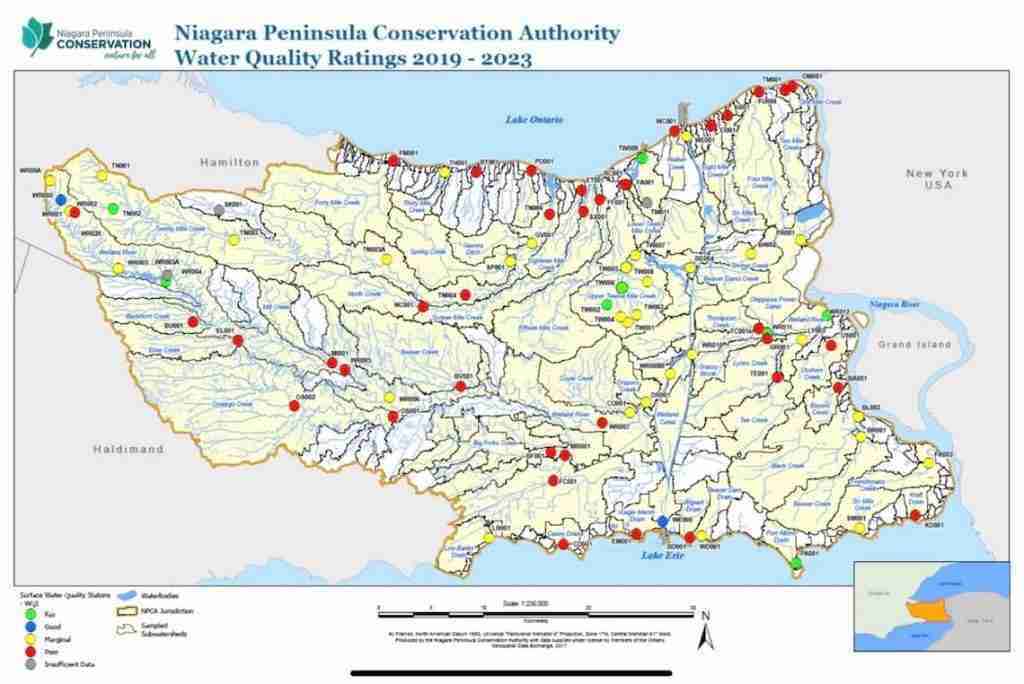
* Image from the Niagara Peninsula Water Quality Monitoring Program Summary Report 2023, June 2024
Toronto
More than 100 millimeters of rain fell in Toronto , flooding streets, Union Station, and subway stations. It closed the Don Valley Parkway. 3,000 homes were flooded and 167,000 households were without power. People were rescued from elevators and from swamped vehicles. Residents in the apartment towers of St. Jamestown were without power for weeks because of outages related to the flooding. The city dumped 500 Olympic-sized swimming pools-worth of partially treated sewage into Lake Ontario. This was the third “100-year storm” to hit the city in ten years, highlighting the fact that Toronto alone cannot pay for its $26 billion flood resilience programs.
“Thank God Everyone’s Okay”
“Thank god everyone’s okay” was Doug Ford’s only response to the record-breaking rains. But knowing what he knows – or should know, given the amount of advice obtained by his government on this very issue – Ford should have taken action long ago.
Because everyone wasn’t okay. And they still aren’t.
The government has tread water for six years through at least five major advisory reports dealing with flooding and the urgent need to adapt to extreme weather. Two of the reports were released as a direct result of SCAN!’s climate adaptation campaign, one of which – the November 2021 report of Ford’s Advisory Panel on Climate Change – is available only on SCAN!’s website, because the government has not posted it.
These reports emphasized the urgent need to invest in infrastructure renewal and stressed the critical roles of conservation authorities and of natural infrastructure such as green space and wetlands.
And then there’s the Private Members Bill, Bill 198, the Ontario Climate Change and Resilience Act, which was largely written by SCAN! It provides a detailed road map of what must be done to protect Ontarians from extreme climate impacts.
So, is the Ford Government making sure everyone’s OK?
Ford’s approach to flooding is about “building public awareness”, making it a private, rather than a government responsibility. The few funding programs that it does have for municipal infrastructure – about $2.6 billion – is a drop in the bucket. Much of it to is to be dribbled out over 3-5 years, and is largely limited to infrastructure projects that support new development. The government’s prioritization of development continues to hobble Conservation Authorities, seen in its latest decision to give its natural resources minister the power to overrule their decisions.
Conservation Ontario, representing Ontario’s 36 Conservation Authorities, gave a grade of “C” for Ontario’s surface water quality and forest conditions in its 2023 Watershed Report Card, saying the findings suggest our watersheds are facing “significant stress.”
It is time for a river of change.
For more information on this issue, check out this Ford Climate Crime
*****
Moya Beall is a member of SCAN!’s Ontario Project and its Adaptation Working Group, Ford’s Bad Energy Choices Working Group, and a member of SCAN! Kawartha.
If you found this blog post interesting and informative, please consider joining the Education Committee and helping with our work. We also welcome comments and feedback. Please contact Sue Craig at martin.bush@outlook.com