
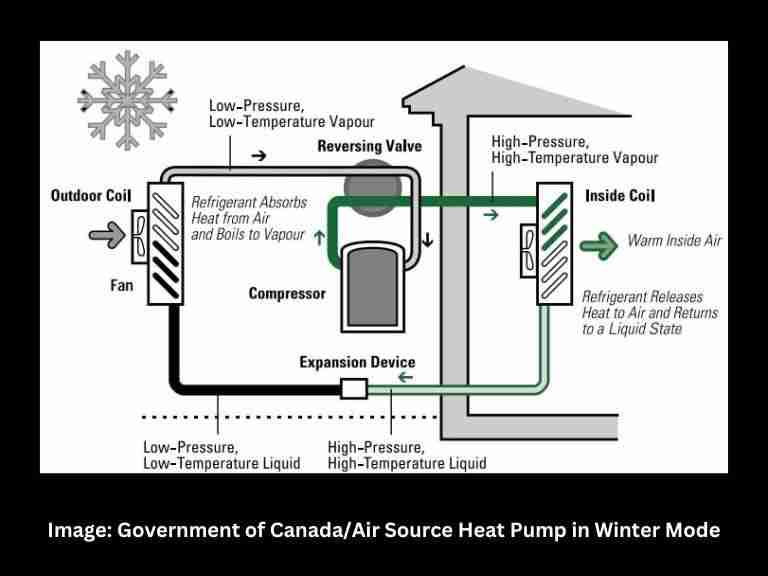
This is about hot stuff and cold stuff, where heat goes, some devices that create cold, some devices that create heat, and what a heat pump does.
What We Learned by Grade 6
Put your fingers around a cold can of pop and feel the heat in your fingers leave and go to the can. Put your fingers around a cup of hot chocolate and feel the heat in the cup leave and go to your fingers. In both cases, heat moves from a warmer object to a colder object. As both examples involved contact of your fingers with an object, the heat transfer was by direct conduction.
But what if there is separation between hot and cold objects? If you are in a building with air conditioning on a hot day, then the ductwork will supply the rooms with cool air. Your warmer body will send heat to the cool air, which makes you feel cooler and more comfortable. In the winter, the ductwork will supply warm air to the rooms, and your cooler body will absorb some of the heat to make you feel warm and comfortable. As both examples involve no contact of you and the ductwork, heat was transferred from the warmer object to the cooler object by convection currents – the air moving through the room you are occupying.
Standing on a beach in a swimsuit on a hot sunny day will warm you up to the point that you feel the need to cool off. You seek shade under a tree and feel cooler. Heat from a very hot sun is radiant heat, similar to radiant heat felt from a campfire. An infra-red quartz tube electric heater heats anything it shines on, via radiant heat. They are used in cold workshops to keep a worker’s hands warm, which is much less costly than using a space heater to heat the entire workshop.
Absolute Zero Degrees
Everything contains heat, until they reach absolute zero (-459.66oF / -273.15oC). A lump of ice at minus 14oC contains heat, and will give up its heat if it comes into close proximity with something that is colder, say an iron bar at minus 24oC.
The Device in the Basement Explained
Now imagine, if you will, a device that can be cold enough to capture the heat out of cold air with an outdoor heat exchanger, and then boost the temperature of the captured heat to a level higher than the temperature inside a building. The high temperature media is then circulated through a heat exchanger in the building ductwork, where the building air is circulated through the ductwork and into the building rooms. The cooler building air in the ductwork absorbs heat from the warmer heat exchanger in the ductwork and distributes the warmer air to the rooms. Amazing! This device is called a heat pump. It is in winter mode.
Now imagine, if you will, that the same device is able to reverse the flow of heat. It sends cool media through the heat exchanger in the ductwork. Warm building air circulating through the ductwork will give up its heat to the colder heat exchanger. The cooler air in the ductwork is distributed to the rooms in the building. The heat pump takes the heat from the ductwork heat exchanger and boosts it to a level that is higher than the temperature of the outside air. Wow! The outdoor heat exchanger will give up its heat to the seemingly cooler outdoor air. This heat pump is now in summer mode, and is often called an air conditioner.
If the device only cools the building air in the summer, and does nothing in the winter, then it truly is an air conditioner. But, if the device heats the building air in the winter and cools the building air in the summer, then it truly is a heat pump.
But Wait–There’s More!
In summer mode, the air circulating in the ductwork contains water vapour – moisture. The water vapour will come in contact with the cool ductwork heat exchanger and condense on it, causing water droplets to form. A pan under the ductwork heat exchanger will collect the droplets and send them to a drain pipe which empties into a basement floor-drain, so that flooding is avoided.
Review
We now know how heat is transferred from a warmer object to a cooler object. We know that everything has heat, even the coldest stuff on earth, which is about minus 80oF (-62oC). And we know how a heat pump works without going into the nuts, bolts, tubing, valves, pressures and compressor.
*****
Peter Nicholas is a Certified Engineering Technologist (Electrical) and Chapter Chair of the London OACETT Chapter. Peter retired from C & C Construction Group (Sarnia) in 2019 as an Electrical Manager and Safety Manager. He is a SCAN! member, on the Education Committee, Ontario Project Group, Seniors Talking Climate Working Group, and the Coordinating Committee. In his spare time, Peter is an energy advisor, a Fixer with the London Repair Café, a Dad, and a Grandpa.
If you found this blog post interesting and informative, please consider joining the Education Committee and helping with our work. We also welcome comments and feedback. Please contact Sue Craig at susan.craig@sympatico.ca