
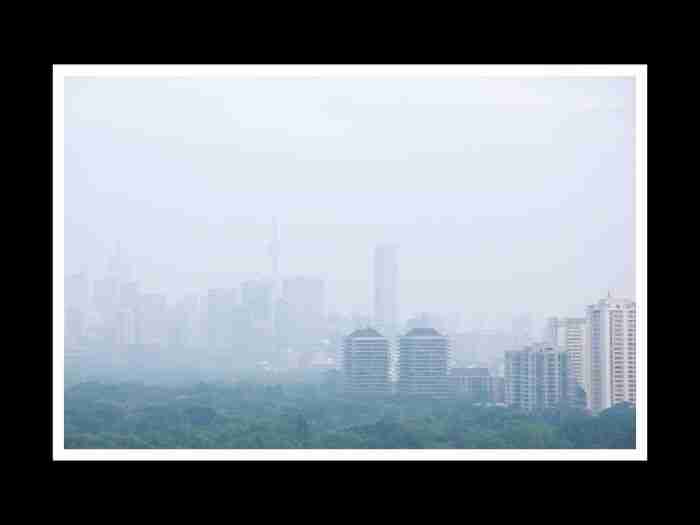
As we shall see, air quality and human health can be rapidly improved by communities and local jurisdictions. In contrast, reducing greenhouse gas emissions will require global cooperation and will take decades. For these and other reasons I will argue that a greater focus on reducing air pollution will increase public engagement with climate change, will improve human health, and reduce greenhouse gas emissions.
Health impacts of air pollution.
Globally, air pollution is responsible for the deaths of millions of people per year. The World Health Organization puts that number at 6.7 million and the Institute for Health Metrics and Evaluation at 8 million. A major source of air pollution results from burning fossil fuels used to power cars and trucks, heat buildings, for power generation, and for industrial processes.
The impacts of air pollution are much more serious in low-and middle-income than in high income countries. But most Canadians would be shocked to learn they are eight times more likely to die prematurely from air pollution than from a motor vehicle accident.
Health Canada estimated 15,300 premature deaths per year in Canada were attributable to human caused outdoor air pollution. Those deaths were more likely in regions of Canada with higher levels of air pollution and air pollution disproportionately affected socioeconomically marginalized groups.
Air pollution affects people at all stages of life from fetal and early stages of child development to old age. It is linked to a wide range of acute and chronic diseases. It affects almost all physiological processes and parts of the body: the lungs, the heart, the brain, the vascular system, metabolism, and reproduction. It increases risk of heart disease, chronic obstructive pulmonary disease, stroke, asthma, diabetes, contributes to dementia, and impacts cognitive and mental development in children.
Air pollution is economically costly.
In addition to premature death and chronic diseases, air pollution is costly. The Health Canada study described earlier, estimated the total economic costs of all impacts from air pollution per year in Canada were $120 billion, equivalent to about 6% of Canada’s gross domestic product (2016 figures).
Large health and economic consequences of air pollution were also reported by an American peer-reviewed publication. Findings from this study evaluated the consequences of rapid climate change mitigation in the United States. This study showed that near-term US benefits of rapid decarbonization were dominated by air quality improvements mostly to human health.
Moreover, these large benefits outweighed the additional costs associated with the transition to low carbon emitting sources of energy. Importantly, actions taken only in the United States to decarbonize would improve its air quality and the health of Americans.
Cleaner air rapidly improves our health.
As we have seen air pollution from fossil fuels increases the risk of premature death, especially for residents breathing more polluted air. But what happens to the health of residents when air quality improves?
This question was addressed in a study that examined the health of Beijing residents who had experienced about half as much air pollution in 2022 compared to the very substantial levels of air pollution in 2013. And it concluded residents in Beijing could be expected to live 4.6 years longer, provided these improvements in air quality were sustained.
The air quality improved in and around Beijing because of steps taken to reduce combustion of fossil fuels near Beijing, not because of overall reductions of air pollution in China or globally. These changes included restricting the number of cars on the road, reducing emissions from the industrial sector in the areas surrounding Beijing, and replacing coal-fired boilers used for heating homes of Beijing residents with gas or electric heaters.
Increasing public engagement with climate change.
Focusing more attention on improving air quality may increase public engagement with climate change. Here’s why.
Many people view climate change as a distant problem. It’s temporally distant because we are told we need to reduce greenhouse gases to net zero by 2050. And it is spatially distant because greenhouse gas reductions require global cooperation.
In contrast, if we were to focus on improving air quality, climate change becomes a problem that can be addressed immediately in local communities. This perspective change is important because, Thaler, a behavioural economist, demonstrated in work that was awarded a Nobel Prize in economics, and many other investigators have shown, people focus on current concerns and ignore or heavily discount future events when making decisions.
Improving air quality in one’s community makes the problem personal and emotional because it affects their health and the health of their loved ones right now.
And critically, it gives agency to community groups and all levels of government because we can take steps to improve air quality and health of people living in that community.
Actions that improve air quality by reducing fossil fuel combustion will also reduce greenhouse gas emissions. For example, replacing a gas-fired furnace or boiler with an all-electric heat pump will reduce greenhouse gas emissions and improve air quality. And building a utility scale renewable source of energy rather than a gas-fired power plant to meet increased demand will not drive-up greenhouse gas emissions and worsen levels of air pollution.
The transition from fossil fuels to renewable energy should evaluate the impacts of its planned actions on both greenhouse gas emissions and air pollution.
*****