
Last October, Ontario’s Auditor-General issued a Report on Progress to Reduce Gas Emissions. With respect to action on climate breakdown, the A-G concluded that not since 2021 has the provincial government “reported on progress.”
That’s because there has been zero progress to report – even as the planet becomes ever more uninhabitable. On the contrary.
The government of Premier Doug Ford reacted to the report by scrapping existing legal requirements to promote emission reductions, explicitly abandoning any sort of climate plan. “If I could tear up every wind turbine in this province I would,” Premier Ford said after being elected in 2018. Ontario wasted more than $200 million by arbitrarily cancelling signed contracts for wind turbines. His apparent rejection of renewables mirrors Donald Trump’s war on wind. Meanwhile, California has now succeeded in getting over half of its power from renewables.
Ontario clearly needs a climate plan. Yet we’re headed in the opposite direction.
Not that things have been quiet on the provincial electricity front. The province now plans to build the world’s largest-ever — and certainly most expensive — nuclear power complex. If the scheme goes ahead, it will be located on the Lake Ontario shore near Port Hope, east of Toronto
The New Nuclear at Wesleyville, as this new project has been dubbed by Ontario Power Generation (a successor to the wreckage of Ontario Hydro), would generate up to 10,000 megawatts of electricity from as many as ten reactors. The cost? York University’s Mark Winfield has calculated that Wesleyville, together with new nuclear plants at Bruce and Darlington and upgrades of existing reactors, add up to over $400 billion in capital expenditures. But, as is the case with proposed nukes, no one knows for sure.
What is certain is that out-of-control cost overruns have indisputably been the cause of the nuclear industry’s chronic migraines.
An American nuclear scheme, Georgia Power’s Plant Vogtle 3 and 4 is the only new reactor project built in the U.S. in more than thirty years. The project’s promoters had promised that it would be on time (six years to build) and on budget ($14 billion). With costs now exceeding $37 billion and after fifteen years of construction, the project now ranks as the most expensive power plant ever built.
This is the territory Ontario’s government wants to enter. In February, Ontario Energy Minister Stephen Lecce boasted that the nuclear refurbishment project at OPG’s Darlington reactor – also near Port Hope — would be “ahead of schedule and under budget.”
Impossible, said the Ontario Clean Air Alliance. The group pointed out that OPG’s own application for a 72 per cent increase in its price of nuclear energy next year shows that “it will have to spend an additional $3.3 billion … to ensure the safe operation of the Darlington Nuclear Station until 2055.”
Uncontrolled nuclear power costs led to the demise of Ontario Hydro. Starting in the 1960s, Hydro built a string of reactors that invariably cost more than expected and took longer to build than planned. They’ve also had to be refurbished at massive cost, with those sums now being paid by ratepayers and taxpayers. Ontario Power Generation (OPG) emerged from Ontario Hydro’s ashes and continues to be saddled with multibillion-dollar nuclear refurbishment costs.
When the first Darlington reactor complex was first proposed in the early 1970s, the nuclear industry was reeling. High costs combined with fresh memories of Three Mile Island and Chernobyl. Protestors scaled the fence at the Darlington construction site. But Premier David Peterson’s government finally caved in to Ontario Hydro pressure and went ahead. The Peterson Cabinet’s savviest member, Attorney-General Ian Scott, had learned not to trust Hydro’s spending estimates. He described the fraught Darlington move “undoubtedly the worst decision the government ever made.”
Ontario could well be in for a high stakes replay.
Those who watched last fall’s World Series and the Winter Olympics are familiar with Ontario’s pricey, hubris-sodden “Protect Ontario” ad campaigns boasting construction jobs and life-saving nuclear isotopes. Borrowing a trope from Stephen Harper and Mark Carney, the Ford government has even started to fly a familiar flag: “Securing Ontario’s future as an energy superpower.”
OPG is betting on nuclear power just as the global energy landscape is changing rapidly and fundamentally. Other historical shifts from one dominant energy source to another (coal to petroleum, for example) have been gradual to say the least. This new shift is both fundamental and rapid. Renewables, once on the periphery of energy planning and development, have become a mainstream economic reality.
The path to renewables is spurred by three things: the threat of ecosystem collapse, economic reality (the plummeting costs of solar energy, wind power, and batteries), and the emergence of distributed rather than centralized energy sources. And let’s not forget about geothermal systems. Decentralized, localized energy systems – in contrast to unaffordable nukes — produce lots of local employment all over the map.
Think of a thousand points of light (solar arrays across the landscape) versus hulking, unwieldy hub-and-spoke systems — a handful of massive power plants such as Ontario’s nuclear power stations crowded across a narrow band of Lake Ontario shore from Pickering to Port Hope. When these are closed for billion-dollar repairs, the Ford government increasingly leans on a rapidly expanding network of climate-killing fossil gas plants.
OPG is planning major expenditures on nuclear reactors just when the cost equations have tipped so overwhelmingly in favour of renewables. With respect to its Wesleyville New Nuclear project, OPG is stunningly unequivocal: “No alternatives to the project are being considered.”
Sounds like Margaret Thatcher’s indefensible TINA dictum that “There Is No Alternative” to market fundamentalism
Should such myopic and absurd thinking prevail, there is every danger that energy superpower mania could push renewables aside in Canada, leaving us lagging behind as the world heads in the opposite direction. A warning: Our grandchildren will be paying the bills. And the Dr. Seuss’s cleverly ominous and massively popular eco-parable, The Lorax, concludes with a warning of its own to young readers: “Unless someone like you cares a whole awful lot, nothing’s going to get better. It’s not.”
For ten detailed reasons to say “No” to New Nuclear at Wesleyville, click HERE.
*****
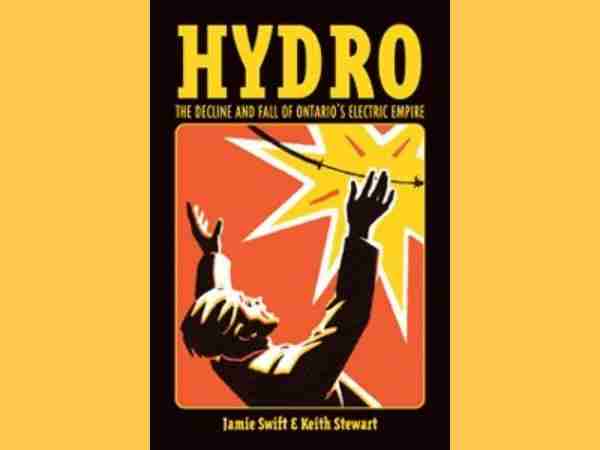
Jamie Swift is the author of a dozen books, including, in 2004, Hydro: The Decline and Fall of Ontario’s Electric Empire (with Keith Stewart). He is a member of Seniors for Climate Action Now! (SCAN!).