Stop Press: The following was written before the Green Party was banished from the televised party leaders’ debates.
Election day is coming up. This time we vote just after Earth Day and Earth Week. Yet you wouldn’t even suspect from the campaign that the biggest peril we face isn’t an unhinged convict in the White House. Or the cost of living here in one of the world’s richest countries.
Not that these aren’t scary enough. But what about the urgent, self-imposed threat our species faces? The deadly menace that imperils our fellow creatures? I’m talking, of course, about climate breakdown. Not “crisis” but breakdown. As a sometime writer, I believe that words really do matter.
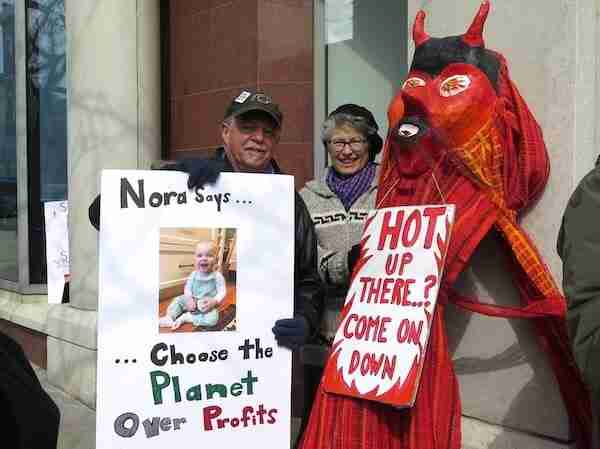
I got involved in climate advocacy by joining SCAN — Seniors for Climate Action Now! — when my granddaughter Nora was born three years ago. By the time Nora gets to be my age, the end of the 21st century will be in sight.
We can’t predict what things will look like in the 2090s, but the signs are grim. I’m terrified when I think of the little girl’s future. Will Nora’s world resemble a hellish, science-fiction apocalypse?
Indeed, many are wondering about the planet’s future. United Nations Secretary-General Antonio Guterres has called what we face “an atlas of human suffering and a damning indictment of failed climate leadership.”
I worry that if today’s elders – people of a certain age, like me – don’t take action on climate breakdown while we still can, future generations will judge us harshly for it.
That’s why a group of people hereabouts has been putting extra effort into Earth Week to remind all of us to pay attention to what SCAN has been calling the Canada We Want during the election campaign.
That means decarbonizing our energy future and restoring our connection to nature. Public transportation, not more highways. Conservation and reuse of materials instead of massive expansion of mining and climate killing fossil fuel projects. A green infrastructure independent of the U.S. A caring and equitable society that recognizes Indigenous rights and sovereignty.
All of this, and more, can be financed by moving wealth from the few to the many. This means special taxes on excess wealth and profits. It would mean boosting Canada’s contribution to high-quality public climate finance that targets adaptation to climate breakdown.
Earth Week’s Kingston theme is Our Power/Our Planet. Plans include church bell-ringing, sustainable craft-making at schools and two Earth Festival days in parks. Given that the federal election unfolds the day after the final Earth Week event (Memorial Centre, April 27, 11AM-4PM) the theme is certainly appropriate.
After the election, we’ll still be pushing for sane policies. Let’s stop frying the planet. Meanwhile, I look forward to sitting with Nora and tucking into The Lorax. Nora’s keen on books.
Dr. Seuss’s clever eco-parable was published in 1971, the year after the very first Earth Day. The story features the mustachioed Lorax who speaks for the trees. And the greedy, insatiable Once-ler’s need for more and more “Thneeds” – fossil fuels. The result is the destruction of Barba-loots, Humming-Fish and all the Truffula Trees.
Yet the Lorax isn’t without hope – Truffula seeds are still around. The massively popular book concludes with a scary warning for us all, especially with an election looming.
“Unless someone like you cares a whole awful lot, nothing’s going to get better. It’s not.”
*****
Kingston writer Jamie Swift was the author, some forty years ago, of “Cut & Run: The Assault on Canada’s Forests.”
If you found this blog post interesting and informative, please consider joining the Education Committee and helping with our work. We also welcome comments and feedback. Please contact Sue Craig at susan.craig@sympatico.ca