
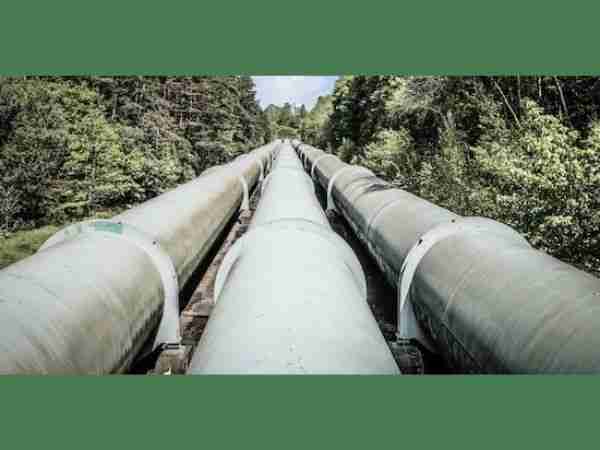
*Photo credit: Wolfgang Weiser/Unsplash
In Davos, on January 25, 2026, Prime Minister Carney declared there had been a rupture, not a transition, in the world order. In response to this breach, he stated the government of Canada has pursued a strategy of building economic strength at home by fast tracking investments within Canada and by diversifying its trade internationally.
One such initiative was the Memorandum of Understanding (MOU) signed by Mark Carney and Danielle Smith on November 27, 2025 in Calgary. The MOU states there will be “construction of one or more private sector constructed and financed pipelines” that will stimulate increased production of Alberta oil and gas for export to Asia. But what would happen if the private sector does not financially commit to this project? That could leave the governments of Alberta and Canada and its residents on the hook for its financing.
Commentary on the MOU has focused on important issues such as whether the BC government and Indigenous groups would support the construction of the pipeline and its potentially harmful environmental impacts. But it has given less attention to whether China and other Asian nations would purchase oil at a price that would make building a pipeline economically feasible because the world is rapidly transitioning from fossil fuels to new renewable technologies.
Rapidly declining cost for and improvement of renewable technologies such as photovoltaic (PV) solar, wind, lithium-ion batteries, and EVs has resulted in their increasing deployment globally and fossil fuel use being squeezed out.
Based on policies that have been adopted or put forward, the Stated Policies Scenario (STEPS) of the World Energy Outlook 2025 of the International Energy Agency (IEA) and Ember Energy, an energy think tank, that seems unlikely. Both organizations, project that peak demand for oil will occur by 2030 and for natural gas by 2035, while demand for renewables will increase by 5.5% per year by 2035.
Future Demand for Fossil Fuels
The STEPS scenario expects the portion of fossil fuel to the total energy mix to decline from 60% in 2024 to 40% by 2035, while demand for low-emissions sources, especially PV solar and wind, will increase in all regions of the world.
Land transport, which accounts for a large percentage of the oil used annually, is projected to decline especially for cars and other light vehicles that use most of that market’s oil. Bloomberg NEF projected global fuel demand for land transport will peak in 2027 due to rapidly increasing EV adoption and fuel-efficiency gains. Sales of electric cars rose by 25% year-on-year, accounting for one in five sales in 2024 and will rise to 50% of the sales by 2035, according to the STEPS scenario.
The STEPS scenario also projects that future demand for fossil fuels will decline due to a dramatic increase in electricity generation, especially from solar PV and wind. Generation from these two renewable technologies has grown by 25% annually over the past five years and is expected to increase by 25% to 2035.
The Current Policies Scenario
The IEA paints another potential path for the global energy future. According to this model, named the Current Policies Scenario (CPS), constraints will slow uptake of new technologies, even when they are mature and widely used. In this scenario demand for oil, gas, and renewables will increase to 2050. This vision of the future is shared by OPEC and oil and gas executives, who have forcefully argued that the peak oil demand projections of STEPS, Ember, Bloomberg NEF, and others are wrong. Chris Wright, Trump’s Secretary of Energy, called the expected peak demand for oil “nonsensical,”arguing that demand for oil and gas will continue to increase.
In Canada, Enbridge CEO, Greg Ebel forecasted robust increasing oil demand to 2050 similar to the OPEC forecast. Premier Danielle Smith of Alberta declared that supplying more oil to other countries is a “global, moral imperative” and asserted that demand for oil is increasing while Pierre Poilievre, promised that a Conservative government would “significantly increase Canada’s oil and gas exports”.
One way to assess the CPS scenario is to review how accurately it forecasted the uptake of PV solar, wind, and EVs between 2019 and 2025. Results showed that these technologies were not constrained in their uptake but were deployed two to three times faster than projected by CPS.
That’s not surprising; other research has shown that past performance and better forecasts of the future growth of renewable technologies are obtained when their costs and deployment are projected to follow an exponential “learning curve” with exponentially decreasing costs and accelerating deployment. In other words, future renewable energy costs will continue to drop, and future deployment will continue to increase. In summary, the STEPS scenario is more plausible than the CPS, though it should be noted the STEPS scenario underestimated the rapid deployment of renewable technologies and should be regarded as conservative.
The Trans Mountain Pipeline Expansion Project, officially opened on May 1, 2024, may well provide a playbook for the future development of the pipelines agreed to in the November 2025 MOU. Plagued by huge cost overruns and lengthy delays, The Trans Mountain Pipeline Expansion Project was challenged by numerous Indigenous and environmental groups, municipalities, and the BC government. Ultimately, the federal government of Canada purchased this project in 2018, unable to find a private-sector buyer.
The Trans Mountain Pipeline Expansion Project should serve as a cautionary tale for the governments of Alberta and Canada. It raises further doubts about whether the private sector will ultimately construct and finance the pipeline as outlined in the Alberta–Canada MOU.
Summary and Conclusions
Although the MOU between Alberta and Canada states that the private sector will construct and finance the pipeline, that seems unlikely. Rapid improvements in renewable energy technologies and their expanding deployment appear likely to cause peak oil demand within this decade. Once consumption of oil and gas declines, that will lead to price collapse as oil producers compete for a shrinking market. That will make financing of the pipeline less attractive to the private sector.
If the private sector is unwilling to fund the pipeline outlined in the Alberta–Canada MOU, that would send a strong signal that the project is uneconomical, and it should not be funded by the governments of Canada or Alberta. Instead, our governments should invest in the rapidly growing renewable energy technologies of the 21st century.
*****
Norman Park is chair of the SCAN! Education Committee and Professor Emeritus in Psychology at York University.